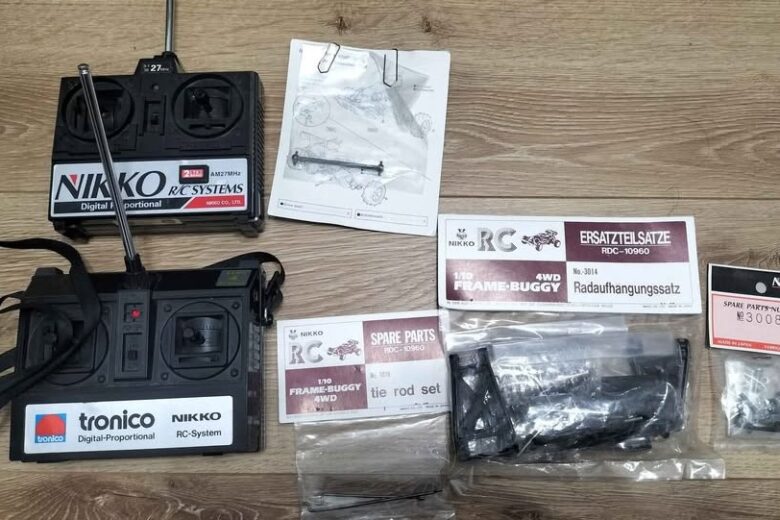
If you’ve ever dipped your toes into the world of remote-controlled cars — even briefly — there’s a good chance you’ve heard the name Nikko. For decades, Nikko has been one of the most recognizable brands in the hobby, and at the heart of many of its early and popular models is the Nikko RC System — a simple, reliable, and nostalgic radio control platform that helped introduce generations to the joy of RC.
What Made Nikko RC So Special?
Long before digital proportional radios became the norm, Nikko made RC approachable. The Nikko RC System was typically a basic controller with simple on/off steering and throttle, often operating on analog radio frequencies. Early Nikko cars weren’t about high-end performance or complex tuning — they were about fun, durability, and accessibility.
Kids and adults alike could unpack a Nikko car, drop in some batteries, and immediately start driving. The system’s appeal was that it just worked, often on 27 MHz or 49 MHz bands that were easy to set up and interfered less with other devices. For many hobbyists, their first RC experience wasn’t a fancy 2.4 GHz digital rig — it was a sturdy Nikko truck with a chunky remote that never quit.
But the simplicity of the Nikko RC System was also its strength. With fewer electronics to worry about, these models were remarkably rugged. They could tolerate bashes, crashes, and the enthusiasm of new drivers without blowing servos or losing trim adjustments. For beginners, this meant less frustration and more time behind the wheel.
Enter Tronico: Nikko’s Vintage Sibling
If “Nikko RC System” sounds familiar, you might also see older models branded as Tronico. Tronico was essentially the brand name used in some markets — particularly in Europe — for what was otherwise Nikko’s RC lineup. The cars, trucks, and buggies were often very similar or even the same models, just sold under a different badge.
For hobbyists who grew up in the ’80s and ’90s, Tronico holds a special kind of nostalgia. Many remember the bright decals, chunky tires, and that distinctive feel of the controller — simple buttons and twin sticks, no proportional steering, just go and turn. In many households, Tronico models were handed down, traded among friends, or used as the very first stepping stone into more serious RC hobbies.
Why These Classics Still Matter
Today’s RC world is full of high-end brushless systems, precision servos, and 2.4 GHz radio gear that feels like it came from a spaceship. But there’s still something charming about the Nikko RC System and Tronico era. Those old analog rigs remind us of a time when RC was more about instant joy and rugged fun than tuning, telemetry, and gear ratios.
For collectors and hobbyists, vintage Nikko and Tronico models also represent an important piece of RC history — the bridge between toy-grade electronics and the hobby-grade sophistication that would come later. And because so many of these older kits were built to survive play by kids, they’re still around today, ready to be restored, displayed, or even run again with fresh batteries.
What You Can Do with Them Today
Restoring a classic Nikko or Tronico RC can be deeply satisfying. A little cleaning, new tires, fresh batteries, and basic radio checks can bring these old cars back to life. Some hobbyists even retrofit them with modern electronics — swapping in a 2.4 GHz transmitter/receiver and a mini servo to give old classics a new lease on life without losing that nostalgic feel.
And for anyone who’s new to RC, exploring these older systems can be a fun way to understand where the hobby came from. There’s a tactile simplicity to Nikko and Tronico that’s sometimes missing in today’s high-tech rigs — and a reminder that RC magic was always about putting wheels in motion and grinning while you do it.
