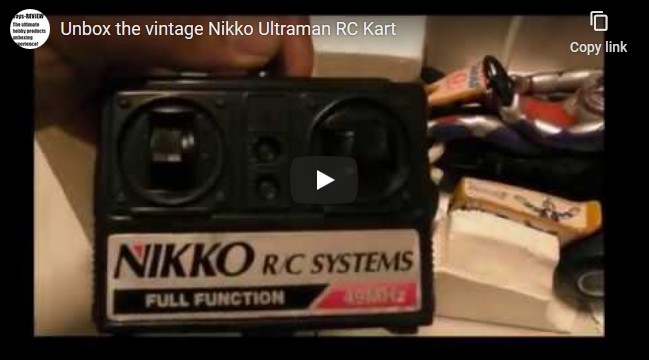
Here comes the vintage Nikko Ultraman RC Kart
Old school small RC kart, powered by AA cells.
The Nikko Ultraman RC Kart is a delightful and somewhat obscure piece of vintage toy history, representing a charming intersection of 1980s pop culture and the accessible, ready‑to‑run radio‑controlled vehicles that Nikko was famous for. This particular model stands out not for its blistering speed or complex engineering, but for its whimsical combination of a beloved Japanese superhero with the simple, unpretentious fun of a small‑scale go‑kart. While its exact release date remains shrouded in the mists of the brand’s extensive catalog, it is a classic example of the small, toy‑grade RC vehicles that brought the excitement of remote control to a generation of children, offering an entry point into the hobby that required no specialised knowledge or expensive equipment.
To fully appreciate the Ultraman RC Kart, one must first understand the company that brought it to life. Nikko R/C, a Japanese brand founded in 1958 by Takeshi Hattori, launched its radio‑controlled product line in 1966 and over the subsequent decades grew to become the world’s largest manufacturer of toy‑grade remote‑controlled vehicles. Unlike the complex and often expensive hobby‑grade kits from brands like Tamiya or Kyosho, which demanded hours of patient assembly and a working knowledge of electronics, Nikko offered ready‑to‑run models that required nothing more than a set of batteries and a desire to drive. This philosophy of making RC fun and accessible is perfectly embodied in the Ultraman RC Kart, which was a simple, self‑contained toy that could be taken out of the box, switched on, and driven immediately, providing instant gratification for its young pilot without any of the frustration of building or tuning.
At its heart, the kart itself was a small, old‑school remote‑controlled vehicle that, in keeping with Nikko’s toy‑grade ethos, offered full‑function control. This meant it could move forward and in reverse, turn left and right, and come to a complete stop, all controlled by a straightforward transmitter with dedicated sticks for speed and steering. Its design was a simple, open‑wheeled go‑kart, a format that has always been popular in the RC world for its playful and approachable aesthetic, evoking the carefree spirit of amusement park rides and backyard racing. The open chassis and exposed wheels gave it a mechanical charm that appealed to children, while the simplicity of the controls meant that even the youngest drivers could quickly master the basics and enjoy the thrill of piloting their own vehicle. What truly set this model apart from the countless other small RC karts on the market, however, was the inclusion of Ultraman himself, the iconic Japanese superhero from the long‑running tokusatsu series produced by Tsuburaya Productions. The kart would have featured the character’s distinctive red and silver color scheme, instantly recognisable to fans of the franchise, and likely included a small driver figure seated in the cockpit, transforming an ordinary toy into a miniature adventure starring one of Japan’s most beloved cultural heroes.
Beyond its obvious appeal to fans of the television series, the Nikko Ultraman RC Kart also serves as a fascinating artifact of a particular era in toy manufacturing, when licensing popular characters for remote‑controlled vehicles was a surefire way to capture the imagination of children worldwide. During the 1980s and 1990s, Nikko produced a vast array of character‑themed RC cars, from Batman to Mario, and the Ultraman kart fit perfectly into this strategy of combining mainstream entertainment with the perennial excitement of remote control. The model was marketed not as a serious racing machine but as a fun, affordable toy that allowed children to recreate their favourite scenes from the Ultraman series in their own backyards, complete with the sound effects and imaginative play that only a character‑driven product could inspire. It occupied a unique niche in the market, appealing both to collectors of Ultraman memorabilia and to young families looking for an entertaining and durable toy that would withstand the rough and tumble of everyday play.
Today, the Nikko Ultraman RC Kart is a sought‑after item for collectors of vintage remote‑controlled toys, its value lying not in its technical specifications but in its nostalgic resonance and its status as a snapshot of a time when toy manufacturing was driven by creativity and character licensing. Finding one in good condition, complete with its original packaging and transmitter, is a genuine treasure for those who remember the golden age of Nikko or who have a deep affection for the Ultraman franchise. As a piece of RC history, it serves as a charming reminder of Nikko’s enduring legacy and the simple joy of a ready‑to‑run remote control car, a vehicle that could transform an ordinary afternoon into a heroic adventure with Japan’s greatest defender at the wheel. Its enduring appeal lies in its ability to transport collectors and enthusiasts back to a simpler era, when the thrill of driving a battery‑powered kart was enough to spark the imagination and create memories that would last a lifetime.
