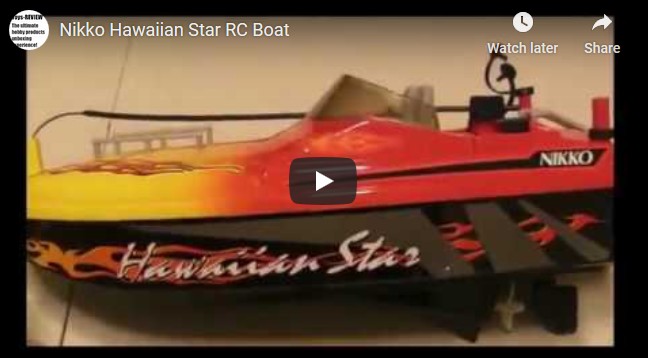
Here comes the vintage Nikko Hawaiian Star RC Boat!
Old school small RC boat, powered by 6 AA cells.
The Nikko Hawaiian Star is a charming and accessible entry point into the world of radio-controlled boating, a small but perfectly formed vessel that embodies the simple, unpretentious fun that made Nikko a household name in toy-grade remote control. It stands as a testament to the company’s philosophy of making RC vehicles available to everyone, offering a gentle and forgiving introduction to the hobby for children and beginners alike, and unlike the high-speed racing boats that demand skill and experience, the Hawaiian Star was designed with a different purpose in mind, which was to provide a safe, manageable, and thoroughly enjoyable experience on the water. This little boat, with its bright colours and friendly design, has become a beloved piece of RC nostalgia for those who grew up with it, representing a simpler time when the joy of piloting a miniature vessel across a pond or pool was enough to spark a lifelong fascination with remote-controlled vehicles.
To understand the Hawaiian Star, one must first appreciate its place within the Nikko lineage and the broader context of the company’s output during its golden years. Nikko R/C, a Japanese brand founded in 1958, had by the 1990s established itself as the world’s largest manufacturer of toy-grade radio-controlled vehicles, offering a vast array of buggies, cars, off-road vehicles, boats, and even aircraft that found their way into toy stores and homes around the globe. The Hawaiian Star was one of the smallest boats ever commercialised by the company, measuring less than thirty centimetres in length, which made it an ideal size for young children to handle and control without feeling overwhelmed by a large or cumbersome craft. Its production period spanned from the 1990s into the present day, a testament to its enduring popularity and timeless appeal, and priced at around twenty-five euros, it was an affordable and accessible gift that could introduce a new generation to the joys of remote-controlled watercraft without placing a significant financial burden on parents. The boat was sold in a variety of colour schemes and even under different names, appearing as the Nikko Sea Astro or Tide Runner, which were identical models marketed under alternative branding to appeal to different markets or retailers, and this approach allowed Nikko to offer the same reliable design with different aesthetic flavours, ensuring there was a Hawaiian Star to suit every taste and preference.
The design of the Nikko Hawaiian Star was deliberately simple and robust, built to withstand the inevitable bumps and splashes of a young captain’s first voyages, and its bright, vibrant colours and dynamic decorations were crafted to catch the eye of a child, evoking the sun-drenched, carefree spirit of its namesake islands. Underneath its colourful exterior, the Hawaiian Star was powered by a small but dependable brushed motor, a modest powerplant that was fed by six AA batteries and provided the energy for its leisurely pace across the water. The top speed of the boat was a gentle two kilometres per hour, a figure that was deliberately chosen to make it easy for children to control and to prevent the kind of high-speed mishaps that could lead to damage or frustration, and while this might seem slow to an adult, it was a perfect speed for a beginner, allowing them to learn the fundamentals of steering and throttle control without the risk of losing control. The transmitter, which required a separate nine-volt battery, offered independent control over speed and direction, though the steering was non-proportional, meaning it was an all-or-nothing affair rather than a smooth, variable response, which simplified the driving experience for young hands.
The control range extended up to fifty metres, giving young captains plenty of room to explore a pond or calm lake, and one of the most appealing aspects of the Hawaiian Star’s modest speed was its impressive battery life, as the small motor drew so little power that the boat could easily run for more than fifteen minutes on a single set of batteries, a significant advantage for eager children who wanted their playtime to last as long as possible. The Hawaiian Star was designed for calm waters, ideally a swimming pool or a still pond, where its gentle nature could be fully appreciated, and its hull featured a fully functional rudder and a single propeller for propulsion, designed to be reasonably watertight for its intended environment. However, it lacked any form of bilge pump or internal flotation foam, meaning that if it capsized or took on too much water, it could sink, and this was a clear indication of its intended use as a toy for protected, shallow waters rather than a serious scale model for open seas. Some versions of the boat also featured special drainage holes to allow any water that did get in to escape, a thoughtful touch that added to its durability and demonstrated that Nikko had considered the practical realities of children playing with boats. Despite this limitation, the level of detail on the deck was surprisingly high for a toy of this class, featuring a helm, seating for passengers, and navigation instruments that added a touch of realism to the play experience and encouraged imaginative play.
The Nikko Hawaiian Star remains a beloved piece of RC nostalgia, a perfect example of Nikko’s ability to create toys that were fun, accessible, and durable, and it was never intended to break speed records or win races, but rather to offer a gentle and rewarding introduction to the world of remote-controlled boating. For an eight-year-old child, it was a gateway to a fascinating hobby, a miniature vessel that could transform a backyard pool into a vast ocean of adventure, and today, it is a cherished memory for those who grew up with it and a delightful discovery for collectors of vintage RC who appreciate its simple charm and historical significance. It represents a simpler time when the joy of driving a little boat across the water was all that mattered, a time before the hobby became dominated by high-performance machines and complex electronics, and its enduring appeal lies in its ability to transport collectors and enthusiasts back to those carefree days of childhood exploration and discovery.
