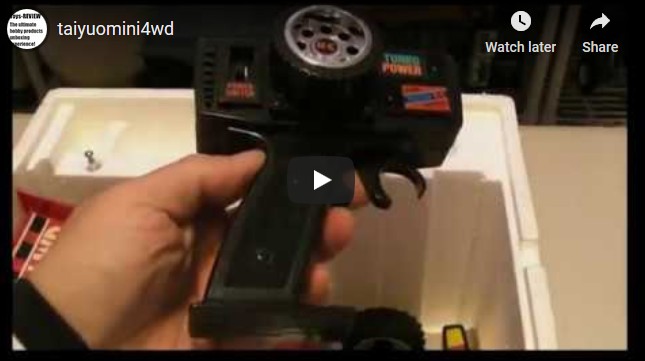
Unbox the vintage RC Aero Super Jet 4WD (Taiyo). It is a 4WD. Front wheels have diffferential. Rear wheels do not.
The Taiyo Aero Super Jet 4WD is a genuine icon of the golden age of toy-grade radio-controlled cars, a machine that perfectly encapsulates the bold, unapologetic spirit of 1980s RC design. Released onto the Japanese market in 1987, this 1:16 scale off-road vehicle arrived at a time when Taiyo was at its peak, producing some of the most beloved and enduring remote-controlled toys ever created. It was a period when the hobby was transitioning, and Taiyo, alongside its partners like Tyco in the West, was pioneering the mass-market RC car, making the thrill of four-wheeled action affordable, durable, and exciting for a generation of children. The Aero Super Jet 4WD stands as a brilliant example of this philosophy, a car that promised speed, power, and the ability to conquer any terrain, and it delivered on that promise with a style and panache that few other toy-grade vehicles could match.
The very name of the model speaks to its ambitions and the design language of the era. The “Aero” designation was a direct nod to the sweeping, aerodynamic styling that was becoming all the rage in the automotive world at the time, influenced by the sleek, wind-cheating shapes that were appearing on supercars and sports sedans. Gone were the simple, boxy shapes of the early 1980s, replaced by flowing curves and aggressive contours made possible by new computer-aided design tools. The Taiyo Aero Super Jet 4WD embodied this futuristic aesthetic with its streamlined body, looking every bit the part of a high-speed, wind-cheating machine that had just blasted out of a designer’s sketchbook. The “Super Jet” moniker further reinforced this image of blistering speed, promising performance that was a cut above the rest and evoking the thrill of jet-powered propulsion. It was a car that looked fast even when sitting still on a shelf, its aggressive lines and chunky off-road tires hinting at the adventures that awaited its owner, a promise of dirt trails, grassy fields, and backyard obstacle courses transformed into high-speed circuits.
Underneath its sleek shell, the Aero Super Jet 4WD was a marvel of toy-grade engineering, built to deliver a thrilling and durable driving experience that would stand up to the rough treatment that inevitably came with enthusiastic play. It was powered by a substantial 9.6V ‘Turbo’ battery pack, which consisted of eight AA batteries, a significant power source for a toy-grade vehicle of its size. This potent electrical system propelled the car to an impressive top speed of 23 kilometres per hour, approximately fourteen miles per hour, a figure that matched the speed of the previous year’s 2WD Jet Hopper MK1 but with the added benefit of superior traction and control. This four-wheel-drive system was a key differentiator, providing a level of grip that was simply unavailable on two-wheel-drive models, especially when driving off-road as the car was intended to be. The Aero Super Jet was equipped with shocks on all four wheels and chunky, treaded off-road tires, making it suitable for tearing through mud, rocks, dirt, and grass without losing momentum or control. The front wheels featured a differential, while the rear wheels did not, a common setup in many 4WD vehicles of the time that helped with steering and power delivery by allowing the front wheels to rotate at different speeds during cornering while the rear wheels provided consistent drive. All of this was controlled by a modern pistol-grip transmitter, a feature that added to the car’s high-performance feel and made it easier for young drivers to control their machine with the precision that the Aero Super Jet demanded.
The Aero Super Jet 4WD holds a particularly interesting place in Taiyo’s history due to the confusion that often surrounds it, a confusion that has become part of its lore among collectors. The model was known by a few different names depending on the country and packaging, sometimes appearing as simply “Super Jet 4WD” without the “Aero” prefix, which has led to endless debates among enthusiasts trying to identify the exact version they own. This naming complexity is compounded by its successor, the Taiyo Super Jet II, which was released in the same year and has caused countless cases of mistaken identity over the decades. To the untrained eye, the two cars look remarkably similar on their boxes, but they are fundamentally different machines with vastly different levels of performance. The Super Jet II was a step down in almost every way: it was a smaller 1:18 scale car, powered by a weaker 7.2V battery, and, crucially, it was only two-wheel-drive, a significant downgrade that completely altered its handling characteristics. The original Aero Super Jet 4WD, with its larger size, more powerful 9.6V system, and superior four-wheel-drive drivetrain, is the one that collectors and enthusiasts truly covet, and the most reliable way to tell them apart is to look at the battery compartment, as the original 4WD model has a sectioned-off area to accommodate the central drive shaft, whereas the Super Jet II has a regular, open compartment.
Today, the vintage Taiyo Aero Super Jet 4WD is a highly sought-after prize for collectors of classic RC cars, its value only increasing as time passes and the memories of that golden era grow more distant. Its combination of striking 1980s aerodynamic styling, robust four-wheel-drive performance, and a powerful 9.6V power system makes it a standout piece from a time when toy-grade RC vehicles were reaching their zenith. It represents the pinnacle of what a mass-market remote-controlled car could be at the time, offering a thrilling and durable off-road experience that was accessible to everyone without the expense or complexity of hobby-grade kits. For those who remember the excitement of unboxing one of these machines on a birthday or holiday morning, the Aero Super Jet 4WD remains a powerful symbol of the simple, unadulterated joy that made remote-controlled cars so magical, a tangible piece of childhood nostalgia that continues to inspire passion and wonder in collectors around the world.
