The name “Amiga Mini” has appeared twice in computing history—and the two machines could hardly be more different. One was a $2,500 luxury PC that used the Amiga name on hardware that had nothing to do with the original. The other is a modestly priced retro console that actually runs Amiga games. Their stories reveal something fascinating about nostalgia, branding, and what happens when a beloved piece of technology gets resurrected.
The First Attempt: Commodore USA’s 2012 Amiga Mini
In March 2012, a company called Commodore USA announced something that made longtime Amiga fans sit up and pay attention. After nearly two decades since Commodore’s bankruptcy, a new machine bearing the Amiga name was finally here.
What It Was
The 2012 Amiga Mini was a compact desktop computer housed in an anodized aluminum case that measured about seven and a half inches square and stood just three inches tall. It bore a striking resemblance to the Mac Mini of that era, with one crucial difference: the classic Amiga logo engraved on the front. Under the hood, the specifications were anything but retro. It featured a quad-core Intel Core i7 processor running at 3.5 GHz, 16 GB of RAM, an NVIDIA GeForce graphics card, a 1 TB hard drive with SSD options available, a slot-loading Blu-ray drive, and WiFi and Bluetooth connectivity.
The machine ran Commodore OS Vision, a Linux distribution based on Ubuntu and customized with a retro-inspired interface. It was, by any technical measure, a powerful little computer.
The Price Problem
Then came the sticker shock. The entry-level model was priced at nearly $2,500. If you wanted a larger SSD instead of the standard hard drive, the price increased significantly. There was a bare-bones option that came with essentially just the case and the Blu-ray drive—a bring-your-own-motherboard affair. For comparison, the original Amiga 500 had launched in 1987 at $699, which was already considered expensive at the time.
The Controversy
The reaction from the Amiga community was swift and, for the most part, brutal. The problem wasn’t just the price. It was the fundamental question: what makes an Amiga an Amiga?
Longtime fans pointed out that this machine had nothing to do with the original Amiga’s custom chipset, its operating system, or its architecture. It ran Linux, not AmigaOS. It used off-the-shelf PC components. Critics noted that simply putting a PC in a small case and putting the Amiga name on it did not make it an Amiga. Others observed that if the machine had shipped with a modern version of AmigaOS rather than a themed Linux distribution, the reception might have been very different.
The 2012 Amiga Mini faded from the scene relatively quickly. It was a fascinating attempt to resurrect a beloved brand, but it demonstrated something important: nostalgia alone isn’t enough. The soul of the machine matters.
The Second Attempt: THEA500 Mini (2022)
A decade later, a very different Amiga Mini appeared. This time, it came from a company called Retro Games Ltd., which had already found success with a similar product for the Commodore 64. In 2022, they released THEA500 Mini, and this time, they got it right.
A Faithful Shrink
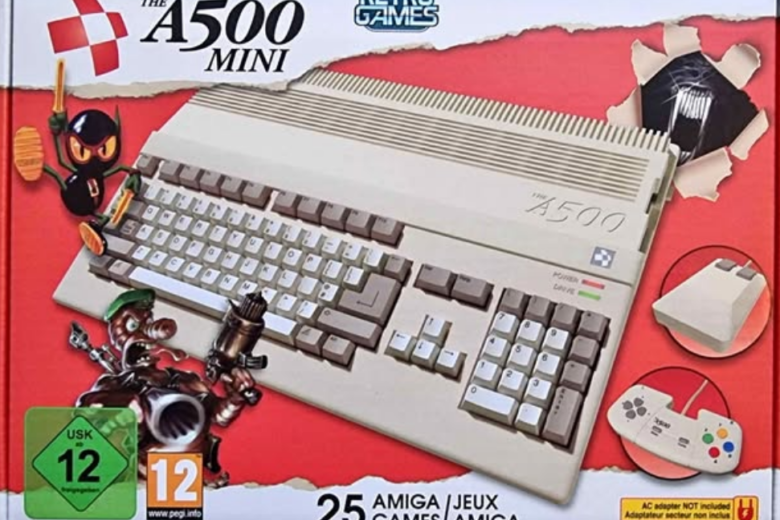
Where the 2012 version had hidden its Amiga heritage behind a Mac Mini clone case, THEA500 Mini wears its identity proudly. It is a half-scale replica of the original Amiga 500, down to the beige color, the keyboard layout, and even the non-functional disk drive slot that serves no purpose other than to make fans smile. The keyboard itself does not work—it is purely decorative—but the overall aesthetic is instantly recognizable to anyone who owned the original.
The package includes a functional replica of the classic Amiga “tank” mouse and a gamepad based on the Amiga CD32 controller. While the mouse has been well-received, the gamepad has drawn criticism for being uncomfortable and making diagonal inputs difficult.
What’s Under the Hood
Unlike the 2012 version, THEA500 Mini does not pretend to be a general-purpose computer. It is an emulation box, pure and simple. It outputs at 720p over HDMI, includes multiple USB ports for peripherals and game loading, and runs emulation that reviewers have praised as solid and accurate. Input lag is minimal—crucial for games that demand quick reflexes.
The machine comes with 25 games pre-installed, a selection that includes genuine Amiga classics such as Speedball 2: Brutal Deluxe, Another World, Worms: The Director’s Cut, The Chaos Engine, Pinball Dreams, Stunt Car Racer, and Qwak.
The USB Factor: Where It Really Shines
The built-in games are fine, but the real magic of THEA500 Mini lies in what you can add yourself. The system supports loading additional games via USB stick, and the community has embraced this enthusiastically.
Reviews and user comments consistently mention this as the system’s killer feature. Many note that if the system only had the games it came with, it probably would not be worth the price, but once you load games from a USB stick, it becomes a great deal. With a reasonably sized USB stick, you can load thousands of games—far more than you will ever have time to play.
The system supports both ADF and WHDLoad formats, and with firmware updates, compatibility is excellent across the Amiga library. It can run software from various Amiga models, including the 500, 600, and 1200, and even some CD32 and CDTV titles.
Save States and Modern Conveniences
One feature that original Amiga owners particularly appreciate is save states. The ability to save your progress at any point and resume later is a modern luxury that the original hardware never offered. No more leaving the computer running overnight because you could not save your game.
The Price Difference
THEA500 Mini launched at around $140 and can now often be found for $100 or less, especially during sales. That is a far cry from the $2,500 of its 2012 namesake, and it puts the device in impulse-buy territory for nostalgic gamers.
Comparing the Two Machines
The differences between the two Amiga Minis run deep. The 2012 version was designed as a general-purpose PC, while the 2022 version is a dedicated retro gaming console. The 2012 machine used modern PC hardware with an Intel processor and discrete graphics, while THEA500 Mini uses custom emulation hardware. The 2012 model ran Linux with a retro-themed interface, whereas THEA500 Mini runs custom emulation firmware that directly mimics the original Amiga environment.
When it comes to Amiga compatibility, the 2012 version offered none—it was designed to run modern applications, not classic Amiga software. THEA500 Mini, by contrast, emulates original Amiga hardware and can play thousands of Amiga games. The price difference is stark: $2,495 versus roughly $100 to $140. The reception followed accordingly. The 2012 version was controversial and widely seen as a branding exercise that missed the point, while THEA500 Mini has been generally well-received as a faithful tribute to the original.
Which One Is the “Real” Amiga Mini?
The answer depends entirely on what you are looking for.
If you wanted a powerful modern computer with the Amiga name slapped on it—something that could run Windows or Linux but bore a familiar logo—the 2012 Amiga Mini was that machine. It was powerful, well-built, and expensive. But to many fans, it was not an Amiga. It was a PC in an Amiga costume.
If you want to actually play Amiga games on modern hardware without the headaches of setting up emulation yourself, THEA500 Mini is the clear winner. It captures the spirit of the original machine, even if it is running on completely different hardware under the hood. The faithful design, the ability to load your own games, and the modern conveniences like save states and HDMI output make it a genuinely appealing package for nostalgic gamers.
The Bigger Picture
The story of the two Amiga Minis reflects something larger about retro computing and nostalgia products. The 2012 version assumed that the name alone would carry the day—that fans would pay a premium for a powerful computer simply because it said “Amiga” on the front. It was wrong.
THEA500 Mini understood something different. It understood that people do not miss the Amiga because of the brand name. They miss what the Amiga let them do: play games that were years ahead of anything else on the market, experiment with creativity software that felt like magic, and be part of a community that celebrated technical excellence.
The 2022 version delivers on that nostalgia. It is not trying to be a modern computer. It is not pretending to be something it is not. It is simply a well-made, thoughtfully designed way to experience the Amiga library again, and that is exactly what its target audience wanted.
THEA500 Mini captures the heart of an era where creativity outweighed processing power and floppy disks ruled the Earth. The 2012 version, for all its impressive specifications, missed that heart entirely.
The Verdict
If someone asks you today about the Amiga Mini, they are almost certainly talking about THEA500 Mini. The 2012 version has faded into obscurity, remembered mainly as a curiosity—an ambitious but misguided attempt to resurrect a beloved brand without understanding what made it beloved in the first place.
THEA500 Mini, by contrast, has found its audience. It is not perfect. The gamepad is poor, the built-in game selection is uneven, and the non-functional keyboard feels like a missed opportunity. But it does the essential thing: it lets you play Amiga games on a modern TV with minimal fuss, and it does so in a package that looks and feels like the machine you remember.
For anyone who spent their youth in the late 1980s and early 1990s with a beige wedge of plastic that seemed to do things no other computer could, THEA500 Mini is a small miracle. The other Amiga Mini is best left to history.
