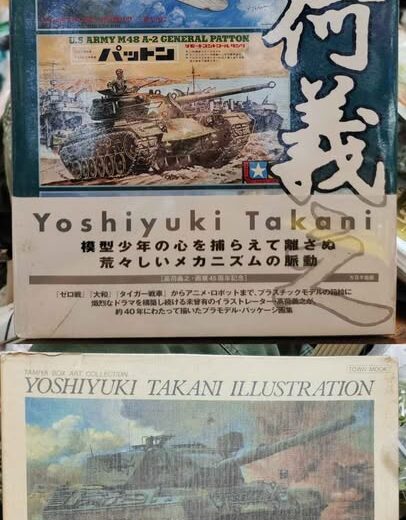
Before the unboxing video, before the high-definition CG render, and even before the plastic sprues were snapped apart, there was the box. For generations of hobbyists, the choice of which model kit to buy—and more importantly, which kit to beg their parents for—came down to one crucial element: the box art.
And in the world of Japanese model kits, no one painted a more compelling picture than Yoshiyuki Takani.
If you were a kid building models in the 1970s, 80s, or 90s, you have likely stared at Takani’s work without even knowing it. His illustrations weren’t just product packaging; they were portals into other worlds. They were the promise of adventure, the smell of the battlefield, and the rumble of giant robots, all captured in oil and acrylic.
From the Battlefields of History to the Cockpits of the Future
Born in Gunma Prefecture in 1935, Yoshiyuki Takani began his career studying under the tutelage of another giant of the industry, Shigeru Komatsuzaki. He made his professional debut at just 19 years old, but the turning point came in 1963 when he started painting box art for model kits.
Throughout the 1960s and into the 70s, Takani became the definitive artist for military models. If you built Tamiya or Nichimo kits of tanks, warships, or aircraft, you were buying Takani’s vision. His illustrations for kits like the German Panzer IV weren’t just technical drawings. One could feel the breath of the soldiers, the cold of the massive tank armor, and even the tension of the battlefield in his work. He had a knack for dramatic lighting and gritty realism that made those gray plastic tanks feel like they had just rolled in from the Eastern Front.
The Shift to Sci-Fi: When Robots Got Weight
The late 1970s and early 80s brought a seismic shift in the model world: the rise of the anime mecha. As science fiction exploded in popularity, Takani pivoted his hyper-realistic style from historical war machines to fictional ones, and the results were revolutionary.
Suddenly, the box art for kits like Mobile Suit Gundam, Combat Mecha Xabungle, and The Super Dimension Fortress Macross looked radically different from the cartoonish drawings that dominated the shelves. Takani treated these fantastical robots with the same seriousness he gave to a Tiger tank. He gave them weight, texture, and a sense of presence.
His illustrations for the Macross franchise are the stuff of legend. Whether it was the sleek VF-1 Valkyrie or the hulking Zentraedi Glaug Battle Pod, Takani’s art made them feel like they existed in a real, physical space. His shapes possessed a mechanically organic quality and a three-dimensional weight to them. You could almost feel the cold metal of the cockpit and the heat of the exhaust.
Perhaps his most iconic mainstream work came in 1984, when he was commissioned to paint the official poster art and pamphlet cover for Hayao Miyazaki’s masterpiece, Nausicaä of the Valley of the Wind. This cemented his status not just as a “hobby artist,” but as a premier illustrator in Japanese pop culture.
A Legacy Painted in Oil
Takani’s influence extends far beyond his own brush. He inspired a generation of artists who followed, most notably Hidetaka Tenjin, who is now the gold standard for mecha illustration. When you see the dynamic, almost photographic quality of modern mecha art, you are looking at the legacy of Yoshiyuki Takani.
His work even crossed over into video games, providing the cover art for classics like Metal Gear 2: Solid Snake, the Strikers 1945 series, and many of the Daisenryaku strategy games. He proved that a static image could hold as much tension and action as any interactive medium.
Even as he winds down his activities in the 2020s, the impact of Yoshiyuki Takani remains as solid as the armor he painted. For the hobby model industry, he was more than just an illustrator; he was the gateway drug. He was the reason a kid would save up their allowance, take that box home, and spend hours trying to make their model look just half as cool as the painting on the lid.
So, the next time you look at a model kit box, take a moment to appreciate the art. And if you see a tank rumbling through the snow, or a Valkyrie soaring against a sunset with that unmistakable gritty realism, tip your hat to the master. Thank you, Mr. Takani, for making our imaginations run wild.
