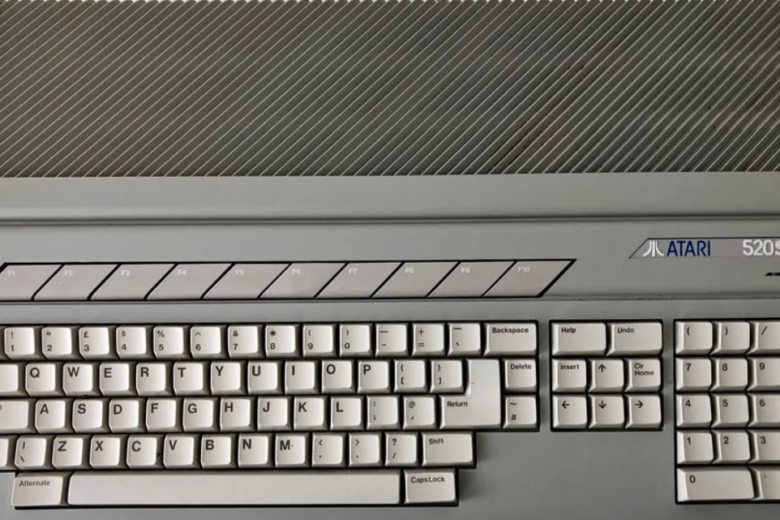
In the mid-1980s, home computers were evolving fast, and Atari took a bold step with the Atari 520ST. Released in 1985, the 520ST was part of the Atari ST family and represented a very different vision of what a home computer could be. It wasn’t flashy in the same way as some of its rivals, but it was powerful, practical, and quietly influential—especially in creative circles.
One of the 520ST’s most important strengths was its built-in graphical user interface. TOS, Atari’s operating system, came with GEM, a mouse-driven desktop that felt modern and approachable. At a time when many computers still relied heavily on text commands, the 520ST offered windows, icons, and pull-down menus right out of the box. For many users, this was their first experience with a true GUI.
Under the hood, the 520ST was built around the Motorola 68000 processor, the same CPU family used in much more expensive systems. This gave it strong performance for the price and made it appealing for serious work as well as gaming. With 512 KB of RAM—generous for its time—the machine lived up to its name and felt ready for multitasking and productivity.
Perhaps the most famous feature of the Atari 520ST was something few people expected to matter so much: built-in MIDI ports. This single design choice made the ST an instant favorite in music studios. Musicians could connect synthesizers and drum machines directly, without expensive add-on hardware. Throughout the late ’80s and early ’90s, the 520ST and its siblings became standard tools for composers, producers, and live performers.
In terms of graphics and sound, the 520ST took a more restrained approach. Its visuals were sharp and clean, especially in high-resolution modes, making it excellent for desktop publishing and design. Sound hardware was simpler than some competitors, but clever programmers still managed to create memorable game audio and music.
Gaming on the 520ST was strong, particularly in Europe. Many arcade and home titles were ported to the platform, and while some games favored other systems for audio or color depth, the ST offered fast, responsive gameplay. It also benefited from a huge library of productivity and creative software, reinforcing its image as a “serious” computer that could still play games when needed.
The Atari 520ST’s legacy lies in its balance. It wasn’t trying to be everything at once. Instead, it delivered power, usability, and affordability in a clean, no-nonsense package. For musicians, designers, and everyday users, it opened doors that were previously closed by cost or complexity.
Today, the 520ST is fondly remembered as a machine that chose a different path—and succeeded. It may not have dominated every market, but its influence, especially in music and creative computing, is undeniable. The Atari 520ST remains a classic example of how smart design decisions can leave a lasting mark on technology history.
