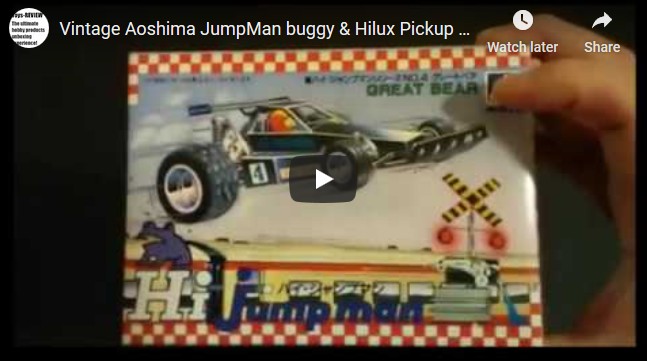
Vintage Aoshima JumpMan Buggy & Hilux Pickup model kits
Aoshima’s JumpMan Buggy and Hilux Pickup model kits offer a fascinating glimpse into two different eras of the Japanese company’s long and storied history in the hobby industry, with the JumpMan series capturing the free-spirited, sun-drenched aesthetic of the 1980s beach buggy craze while the Hilux Pickup kits represent a more modern focus on the highly detailed, customizable replicas of iconic Japanese vehicles that Aoshima is celebrated for today. Both ranges, however, share the company’s commitment to quality and a deep appreciation for automotive culture, and together they tell a story of how scale modelling evolved in Japan over the course of two decades.
The JumpMan Buggy series was very much a product of its time, emerging in 1985 when the beach buggy was a symbol of a laid-back, adventurous lifestyle that captured the imagination of young people around the world. These were not radio-controlled vehicles but rather static plastic model kits, designed to be carefully assembled and proudly displayed on shelves rather than driven across dirt tracks. The series was remarkably prolific, encompassing a wide array of models under the JumpMan banner, and the lineup included the Jump man Wild Buggy, the Jump man Pro Protector, the Hi jump man Arrow Stoom, the Jump man Cut Back, the Jump man Pro Top Seed, the Jump man Tom Cat, and the Jump man Jack Rabbit, among many others, demonstrating just how invested Aoshima was in this particular theme. The series even included offshoots like the Sand Jump man Suzuki LT250R Quad Buggy and the Wild Jump man Willys Jeep, which showed the range of subjects that the beach buggy concept could encompass, from four-wheeled dune buggies to all-terrain utility vehicles. Each kit was typically presented in a rigid, top-opening box, which was a hallmark of quality model kits of that era and promised a satisfying building experience from the moment the hobbyist lifted the lid.
The model kits themselves were compact, with a standard box size of approximately 150 by 110 by 40 millimetres, making them convenient for both storage and display once completed. They were all released as new tool kits in 1985, meaning they were created from fresh molds specifically for this series, which underscored Aoshima’s significant investment in the line and their confidence in its commercial potential. These kits allowed hobbyists to build and customize their own miniature beach buggies, capturing the essence of a cultural moment when open-topped, rugged vehicles were synonymous with fun in the sun, carefree road trips, and the kind of coastal adventures that seemed to define a generation. The attention to detail in the moulding captured the distinctive curves and open structures of real beach buggies, and the optional parts included in many of the kits gave builders the freedom to personalize their models. Today, these kits are highly sought-after vintage items, with their original packaging and untouched sprues representing a tangible piece of 1980s modelling history that collectors treasure for both their nostalgic value and their historical significance within the hobby.
In stark contrast to the historical charm of the JumpMan series, Aoshima’s Hilux Pickup model kits are a testament to the company’s enduring popularity and its focus on modern, highly detailed replicas that appeal to a new generation of model builders. These kits are predominantly one-twenty-fourth scale models of the iconic Toyota Hilux, with a particular focus on the 1994 LN107 model, which is considered a classic of the Japanese pickup truck lineage. This model is available in several popular variations, the most celebrated of which is the Double Cab Lift Up version, which immediately captures attention with its aggressive stance and off-road capability. The appeal of these kits lies in their celebration of off-road and modified truck culture, a scene that has grown enormously in popularity around the world and has become a vibrant subculture in its own right. They feature a specially designed chassis that significantly increases the ride height, paired with large, aggressive tires that give the model a commanding, rugged stance ready to conquer any terrain, from muddy trails to rocky mountain paths.
The detail and quality of these Hilux kits represent a significant step up from the older JumpMan series, reflecting decades of advancement in injection moulding technology and Aoshima’s own refinement of their design processes. They often include chrome-plated chassis components for a premium look that catches the light beautifully, stylish aluminum wheels that add a touch of sophistication, and practical touches like window frame masking stickers to assist with painting, which make the building process more accessible to modellers of all skill levels. Aoshima offers several distinct Hilux kits, each with its own character and appeal, including the Tuned Car series numbers for both the LN107 and the earlier RN30 Hilux Custom from 1978, as well as the Hilux Surf Lift Up for the SUV variant that shares the same robust engineering. The Double Cab four-wheel-drive version faithfully recreates the real truck’s stylish and practical interior, which can carry four passengers in comfort, and its three-litre series four-cylinder overhead-cam diesel engine, a powerplant that was renowned for its durability and reliability in some of the world’s toughest driving conditions. The kits also come with a variety of optional parts, such as over-fenders, roll bars, and fog lights, allowing modellers to create a custom truck to their exact liking and to express their own vision of the ultimate off-road machine.
The packaging of these modern kits reflects their larger and more complex nature, with dimensions around 32.5 by 21.5 by 8 centimetres, and the box art is typically vibrant and dynamic, showcasing the finished model in dramatic off-road poses that inspire the builder from the very first glance. They are part of ongoing production and re-release schedules, with the Double Cab Lift Up ’94 model, for instance, having a release date as recent as September 2025, which speaks to the enduring popularity of the Hilux as a subject and to Aoshima’s skill in producing kits that appeal to both nostalgic builders who remember the original trucks and new enthusiasts discovering them for the first time. While reviews note that these are curbside models without opening hoods, meaning the engine detail is not visible once the model is complete, the interior and exterior details are consistently praised for their high quality and accuracy. From the sun-drenched beaches of the 1980s to the rugged off-road trails celebrated today, Aoshima’s JumpMan and Hilux kits represent two distinct but equally passionate chapters in the story of Japanese scale modelling, each offering a unique window into the automotive culture of its time and a rewarding building experience for hobbyists of all ages.
