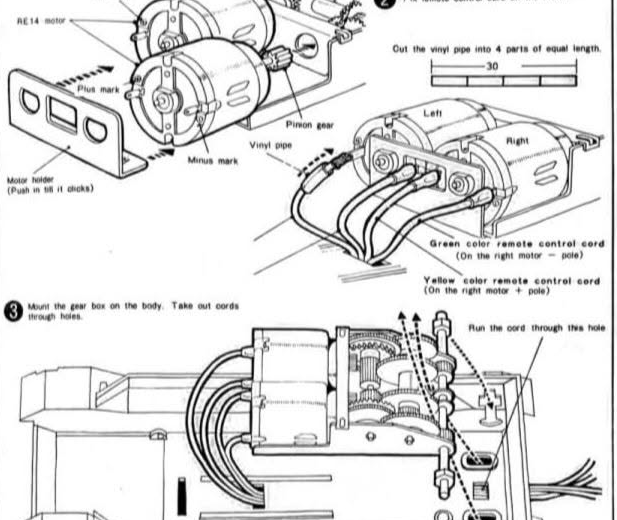
Assembling the drive system of a remote-controlled tank is a delicate process that requires careful attention to motor orientation, wiring polarity, and cable management. The instructions provided in this guide outline the specific steps for building the vintage wired RC variant of the Nichimo model. The assembly begins by preparing the dual-motor drive unit. Two RE14 motors must be fitted with pinion gears, which are secured onto the motor shafts by gently tapping them into place. It is crucial to observe the distinct plus and minus marks on the motor casings to ensure they are oriented correctly before being inserted into the motor holder. The holder itself is designed for a snap-fit, requiring the builder to push the motors in until they click securely into position. A small section of vinyl pipe is also utilized here, bridging the two motors as a spacer or protective conduit for the initial wiring.
Once the motors are physically mounted, the focus shifts to establishing the electrical connections for remote control. The wiring harness must be attached to the rear terminals of the motor assembly with strict adherence to polarity. The guide specifies exact color-coding for these connections: the green remote control cord must be attached to the negative pole of the right motor, while the yellow cord connects to the positive pole. To ensure the wiring remains tidy and insulated, the instructions also call for a separate piece of vinyl pipe to be cut into four equal segments, each measuring 30 millimeters in length. These small tubing sections are likely intended to slide over the soldered joints or exposed terminals to prevent short circuits.
The final phase of this assembly involves integrating the completed motor and gearbox unit into the tank’s main body. The entire assembly is carefully lowered into the lower hull, and the wiring harness must be routed precisely as directed. The instructions emphasize taking the cords out through designated holes in the chassis, ensuring they run cleanly through a specific opening in the side wall. By keeping the bundled wires away from the moving gears and internal mechanisms, this careful cable management prevents interference and protects the delicate connections, ensuring the tank’s drive system remains functional and reliable once fully assembled.
