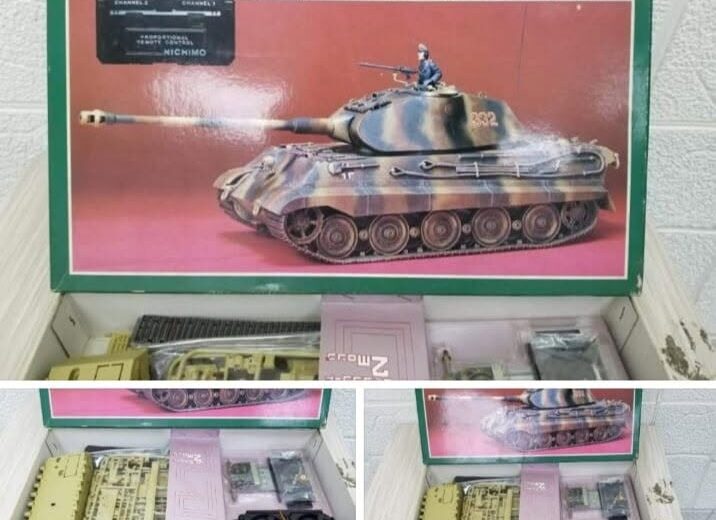
If you grew up building models in the 1970s, the name Nichimo might ring a bell. This Japanese manufacturer carved out a niche for itself with a range of 1:35 scale armor kits, and among their most intriguing releases was a series of remote-control Tiger II tanks. These weren’t just static display pieces—they were functional models that brought a little piece of armored warfare to your living room floor.
Nichimo’s foray into RC tank territory came with the Pz.Kpfw.VI Tiger II Porsche Turm, released around 1975 under the catalog number R-3527. This was a bold move for the time. While Tamiya was dominating the static armor market, Nichimo was experimenting with making tanks that actually moved.
The early Porsche turret variant is particularly interesting from a historical modeling perspective. Only fifty Porsche-turreted Tiger IIs were ever produced before the design was switched to the more familiar Henschel turret. Finding a kit of this specific variant in 1:35 scale was a rarity back then, and it remains a curiosity today.
Nichimo didn’t just release one Tiger II and call it a day. The company seemed to have a restless approach to their catalog, spawning multiple variants and boxings across the 1970s and into the 1980s. The NR-3506 appeared in various configurations, sometimes labeled as a standard Tiger II and other times as the Henschel turret version. Then there was the NR-3510, confusingly also labeled “Porsche Turm” despite the existence of the earlier R-3527. If that wasn’t enough, a kit labeled simply “Royal Tiger” also carried the NR-3510 number.
This kind of catalog chaos was common among smaller manufacturers of the era. Tooling was expensive, so kits were reused, reboxed, and rebranded with little consistency. For collectors today, it makes tracking down specific versions an enjoyable detective game. One modeler noted that the kit doesn’t even include a manual, though downloads can be found on various sites.
These were remote-control models in the truest sense of the term for their era. Nichimo designated them as “RC model kits” and “functional model kits”—a distinction that set them apart from the static offerings that dominated hobby shop shelves. The appeal was obvious: you could build a detailed 1:35 scale Tiger II and then actually drive it around. It combined the satisfaction of construction with the thrill of operation. For kids of the 70s, this was as close to commanding a real Königstiger as you could get without joining the military.
Here’s the thing about Nichimo RC tanks today: they’re ghost kits. A quick search across modeling databases reveals a consistent refrain—no partner shops have them for sale, and there are no in-box reviews available. These kits have essentially vanished from the secondary market. When they do surface, usually on auction sites or estate sales, they command interest from dedicated collectors who appreciate their historical significance. A 2018 auction listing for a group of Nichimo RC tank kits, including a Porsche Turm Tiger II, estimated the lot at £60 to £80, though the kits were marked “motor not included”.
One modeler who acquired the Porsche Turm version described it as a simple kit with correct shapes, noting that while it lacks the detail of modern offerings, it remains a good platform for detailing. The absence of documentation makes each surviving example something of a mystery—what exactly was in the box? How did the RC mechanism work? The lack of reviews and instructions online only adds to the intrigue.
Nichimo’s RC tank experiment was ultimately a footnote in modeling history. The company is remembered more for its static armor and aircraft kits, and the RC Tiger II line didn’t achieve the longevity of Tamiya’s later forays into the RC tank market. But for those who remember them, these kits represent a fascinating moment in the hobby’s evolution. They were an attempt to blur the line between model and toy, between display piece and plaything. In an era before digital controls and lithium batteries, Nichimo was experimenting with what a model kit could do, not just what it looked like. If you ever stumble across a dusty box at a swap meet with “Nichimo” and “Remote Control” on the label, take a closer look. You might be holding a piece of modeling history—a Tiger II that was built to roll.
